Hotel Slippers Wholesale: The Complete Buying Guide for Hotels and Distributors
Slippers are the amenity guests notice first and the one they take home most often. They are also the item where a small specification change moves your annual spend by a five-figure sum — so it is worth specifying properly rather than ordering by photo.
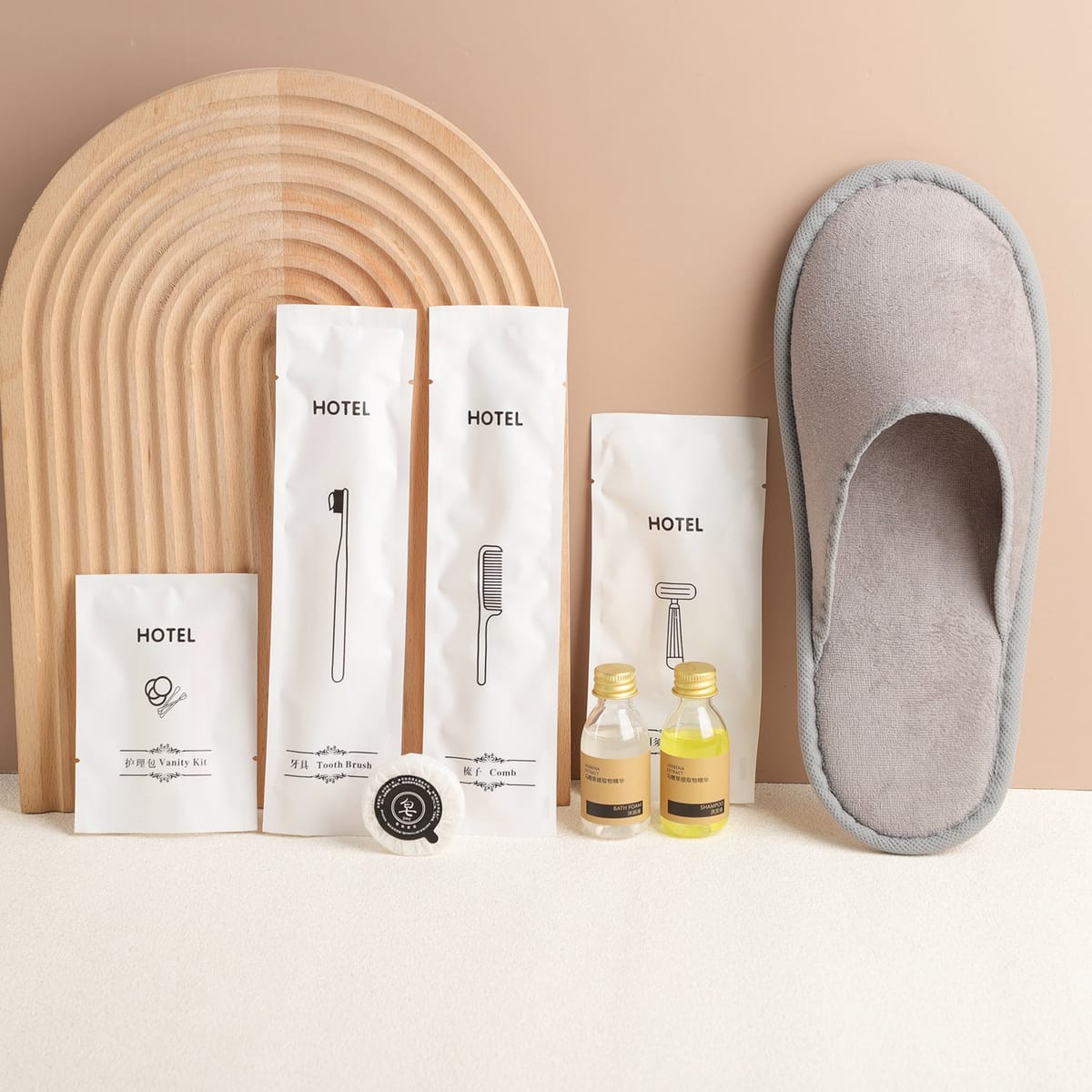
A 200-room hotel running at 75% occupancy consumes roughly 55,000 pairs a year. At that volume, the difference between a 3mm EVA sole and a 6mm EVA sole, or between polybag and non-woven packaging, is not a detail — it is a budget line. This guide explains the specifications that actually matter when buying hotel slippers wholesale, how each one changes cost and guest perception, and what to check before you place a repeat order.
1. Closed-toe or open-toe?
The two shapes serve different guest expectations, and most properties end up using both.
| Style | Best for | Typical material | Guest perception |
|---|---|---|---|
| Closed-toe (slipper moc) | 4-5 star rooms, suites, spas | Coral fleece, terry, waffle | Premium, feels like a gift |
| Open-toe (thong / slide) | 3-4 star rooms, resorts, poolsides | Felt, EVA, non-woven | Practical, light, disposable |
| Foldable travel style | Airlines, business hotels, gyms | Microfibre with pouch | Compact, 'to take away' |
If your guest mix is mostly leisure travellers staying several nights, closed-toe in coral fleece is the safer choice: it survives multiple wears and photographs well in reviews. For high-turnover city hotels with one-night stays, an open-toe felt or non-woven slipper delivers the same function at a materially lower cost.
2. Material: what the guest actually feels
Material determines warmth, breathability, durability and how the slipper looks on the bathroom floor. Four options cover almost every hotel programme:
- Coral fleece — the softest and warmest option, with a plush pile that holds up to two or three wears. Standard for 4-5 star guest rooms in cool climates.
- Terry cotton — absorbent and familiar, similar to a hotel towel. Popular in spa and pool settings where guests expect cotton next to skin.
- Wool felt — firm, shape-retaining and cheap to produce. Excellent for high-volume 3-star programmes where disposability matters more than hand-feel.
- Waffle / linen blend — lighter and more breathable, suited to tropical resorts where fleece feels excessive.
A frequent mistake is buying fleece for a beach resort. Guests arrive hot and sandy, the pile traps moisture, and housekeeping reports damp slippers in the room. Match the material to climate before you match it to budget.
3. Sole thickness: the specification that decides durability
Sole construction is where cheap slippers fail. A 2-3mm EVA sole is fine for a single night but transfers every tile edge to the guest's foot; below 3mm the slipper also tends to curl at the toe after one wear. For anything above a 3-star positioning, specify 5mm or more.
| Sole | Thickness | Use case | Relative cost |
|---|---|---|---|
| EVA foam | 3mm | Economy, one-night stays | Low |
| EVA foam | 5mm | Standard 4-star, comfortable underfoot | Medium |
| EVA + fabric laminated | 6-8mm | 5-star, suites, spa; anti-slip pattern | High |
| Anti-slip rubberised | 5mm+ | Wet areas, pools, spas | High |
4. Size and fit
Hotel slippers are almost always one-size with a length range of roughly 28-30cm, which fits EU 37-44. If your guests skew large — North American and Northern European markets — ask for the longer 30-31cm last. Too-short slippers are the single most common guest complaint about this amenity, and it costs nothing to specify correctly.
5. Packaging: the cheapest perceived-value upgrade
The same slipper in three different packages reads as three different products. Packaging is a modest share of unit cost and the most visible part of the guest experience.
- Polybag — lowest cost, purely functional. Fine for back-of-house or 3-star programmes.
- Non-woven pouch with printed logo — the workhorse of 4-star hotels; adds a premium feel for a small increment.
- Kraft paper or recyclable board box — supports sustainability positioning and photographs well.
- Drawstring cotton bag — for spas and suites; expect a noticeable cost step up.
Whatever you choose, ask for the packaging to be sealed rather than open-ended. Sealed units let housekeeping confirm the slipper was never used, which matters for both hygiene claims and guest confidence.
6. MOQ, lead time and reorder stability
Our standard custom MOQ is 5,000 pairs per design, with 15-20 days production after artwork approval and 5-7 days for sampling. Stock programmes with existing packaging can ship faster. The number worth focusing on is not the first MOQ but the reorder MOQ — if your supplier cannot repeat the same fleece batch, colour and print position six months later, your rooms will visibly drift.
Ask two questions before signing: how long do you retain my artwork and material specification, and what is the minimum for a repeat order in the same colour? Suppliers who cannot answer clearly are usually trading, not manufacturing.
7. The sample checklist buyers should actually use
- 1Weigh the pair. Fleece slippers under about 90g per pair are thin; 110-140g is a normal 4-star weight.
- 2Bend the sole. It should flex at the ball of the foot without creasing permanently.
- 3Wet-test the sole on a tiled floor — a genuinely anti-slip outsole grips when damp.
- 4Pull the lining seam. Loose stitching shows up here first, long before guests complain.
- 5Wear the pair for an hour at home, then check whether the toe box has deformed.
- 6Compare the printed logo against your brand guide under daylight, not office lighting.
- 7Confirm the carton count and carton weight — this drives your freight and storage cost.
8. Three mistakes that show up in audits
- Buying on unit price alone and discovering the carton is 50 pairs instead of 100 — the per-pair saving disappears in freight and handling.
- Approving a photo instead of a physical sample, then receiving a different fleece pile height.
- Letting artwork sit with the factory without a written approval step, so a print position error is only caught at the container.
Slipper sourcing is not complicated, but it is specification-driven. Decide the material and sole before the price, approve a physical sample, and lock the repeat specification in writing. If you want a comparison against your current supplier, send us a pair and we will tell you where the cost and quality differences sit — see our guest slipper range or the full product catalogue.
Frequently Asked Questions
What is the minimum order quantity for custom hotel slippers?+
5,000 pairs per design for custom logo and packaging. Stock designs in existing packaging can be ordered at lower quantities.
How long does production take?+
5-7 days for samples, then 15-20 days for mass production after artwork approval. Freight to Europe or North America typically adds 25-35 days by sea.
Can you match a slipper we already buy?+
Yes. Send a physical sample or clear photos with weight and sole thickness and we will confirm whether we can match it exactly or propose the closest equivalent.
Need this specification quoted for your property?
Send your room count, star rating and target unit price. We reply with a costed specification, not a catalogue page — usually within 12 hours.
Continue reading
Wholesale Pricing
Hotel Amenities Wholesale Quotes Explained: Why Two Suppliers Price the Same Kit Differently
Why hotel amenities quotes differ: the six variables behind every price — material, fill volume, packaging, printing, quantity and freight.
OEM & Customization
Custom Hotel Amenities With Your Logo: OEM Process, Artwork and Realistic Timelines
How hotel branding on amenities works: embroidery, silk screen, hot stamping, soap embossing, artwork files, proofing, MOQ and lead times.